Thursday, 25 November 2010

WARNING! WARNING! There will be violence in this post!


SCREEN VIOLENCE

In this lecture we examined the claim that exposure to screen violence causes desensitisation in today’s youth. Bill discussed On Killing by Lt. General Grossman who argues that violent videogames (or “murder simulators” as he prefers to call them) work in the same way as modern army combat training to acclimatize soldiers to the concept of killing. In World War II it is reported that the majority of soldiers never fired their weapons, because as human beings most of us have an innate resistance to killing another person (yet it's so easy to murder poor little animals what's the difference really? Humanity disgusts me.) So after the war the government introduced measures to break down this resistance and instill the 'warrior instinct' to provide the necessary aggression to meet the enemy unflinchingly in the important situation of kill or be killed. Apparently it really worked but i don't see why they had a problem anyway i think modern warfare's cowardly. Where's the bravery in shooting some speck in the distance or bombing people with a missile while you're all cosy inside? I'd be so pissed off if someone shot me, i mean if you're gonna kill me at least get my blood on your hands. 


Maybe videogames with their infamous headshots have caused this but i doubt it. After the shocking Columbine school shooting people blamed the shooters, Eric Harris and Dylan Klebold's  actions on a videogame, Doom that they were obsessed with. It was a first player shooter game with graphic and interactive violence. The movie Natural Born Killers (1994) which follows a pair of mass murderers was also targeted as was poor Marilyn Manson and the Goth subculture even though the shooters were found to not like Manson's music or be any more involved in Goth subculture than wearing trench coats. Whether or not Harris and Klybold were emulating Doom when they killed 12 fellow pupils and 1 teacher, is pointless speculation to me. Thousands of other kids played that game and the massacre was just one isolated case so it's clear to me that they would be likely to commit these crimes regardless of any media influence. Most people are able to differentiate between what we see in the media and what is real life and I think it is unfair to condemn screen violence just because a tiny percentage of people cannot. For example, I don't play videogames (i enjoy watching someone play one with a good storyline though) but I love horror and gore films with with a sick pleasure and listen to supposedly satanic music yet i'm overly empathetic and a vegetarian and feel in no way that i've been influenced to shoot someone in the face. 


Oh, i would rip out Ruggero Deodato's eyes and make him eat them though for killing 7 animals (1 of them just for a reshoot) in Cannibal Holocaust (1980)!  Which brings me onto what we discussed in our seminar: what are our responses to violence in films and what are our limits?  


I'm not really shocked or disgusted by anything i've seen, i know humans are capable of all the horrific things portrayed in films and worse. My favourite is in Hostel 2 when the ugly chick gets strung up naked and a goth chick walks in with a scythe and proceeds to slice the girl up and bathe in her blood. This is obviously based on the legend of 'The Blood Countess', one Elizabeth Bathory who supposedly bathed in the blood of virgin girls to retain her youth. I'm sure goat's milk would have been less messy.
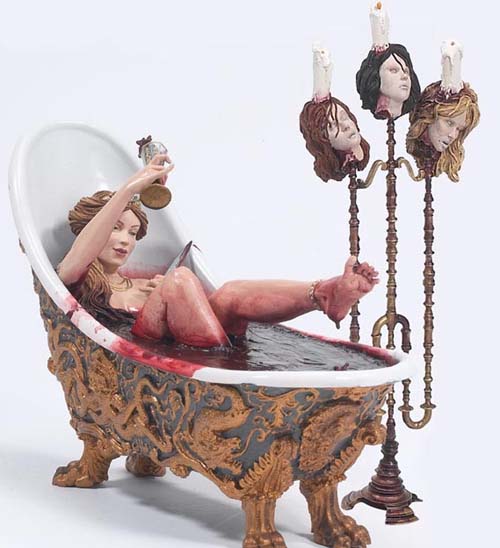

 But horror films are just getting silly now trying to be more gross and disgusting than the last with no real storyline. *yawn* We know they're not real so they have to rely on excellent special effects to make the films even worthy of watching and merit. Of course there is the matter of 'snuff films' which would be very different if they actually exist. The aforementioned Cannibal Holocaust was so strongly thought to be a real snuff film that Ruggero Deodato had to appear in court with the cast to prove they were actually still alive. The fact that he had actually mutilated and murdered several animals just for the purpose of the film didn't matter though urgh! That's where i draw the line. Do not bring animals into humanity's sick desires! There was just no need, he clearly had a great special effects team working for him to make the human deaths seem so real why couldn't he do the same with the animals? I felt similarly uncomfortable watching Freaks as i knew the cast were real deformed people. I would've reacted differently if it was prosthetics i could've admired the creative skills then but i just felt awkward and bad watching real people =S 


Not that i think they should be censored. Humans are violent sexual beings and any attempt to deny this is just self denial. Just because we don't go out raping and murdering it doesn't mean we don't have the capability to do so we just choose to live more moral lives. Our ancestors were prone to such acts we just live in a more civilised culture now where that behaviour is rightly disproved of and punished. Ivan suggested that we enjoy screen violence so much because it's a form of catharsis and i believe this also.If we didn't watch these films featuring fictional people pretending to smash peoples head's in maybe we would go around doing just that.  


30 Seconds to Mar's Hurricane video was first banned then censored to death because of it's terrible violent and sexual scenes. Grow up. It's not even that bad it's an exploration of our dark dreams and secret fantasies and people shouldn't hide from this.


Flyleaf's Cassie is based on the alleged exchange between Cassie Bernall and Eric Harris in which the latter asked the former if she believed in God and when she answered 'yes' he shot her dead. 


Sunday, 21 November 2010

Genre Lecture

Bill started by expanding upon Ivan's explanation of semiotics.

Pierce's Tripartite Classification of Signs:

  • Symbol -arbitrary- analogous to Saussure's linguistic analysis
  • Icon -likenees, resemblance - No analogy in Saussure's
  • Index -'existentially linked' (eg. where there is smoke, there is fire) - No analogy in Saussure's 


Boulevard du Temple by Louis Daguerre is believed to be the first photograph to feature humans as the exposure lengths at this time, 1838, was 10 minutes and nobody stayed put for that length of time to show up in a photograph. But in this scenic photo there is a man getting his shoes shined and a couple sat outside a cafe who stayed still and so unwittingly became the subjects in this seminal photograph.

Bill discussed how culture changed due to the creation and developments of photography. Artists found that with photography taking care of realism and perspective it freed them to be more creative and thus Dadism and Cubism and Modernism and a whole host of other 'isms' were born!

Andre Bazin, a French theorist and film critique argued that photography and cinematography are indexical, they are existentially linked to each other. Bill only mentioned his theories about film but i've found out that Bazin wrote a lot about physical modelling also:
If the plastic arts [painting and sculpture] were put under psychoanalysis, the practice of embalming the dead might turn out to be a fundamental factor in their creation. The process might reveal that at the origin of painting and sculpture there lies a mummy complex. The religion of ancient Egypt, aimed against death, saw survival as depending on the continued existence of the corporeal body. Thus, by providing a defence against the passage of time it satisfied a basic psychological need in man, for death is but the victory of time. To preserve, artificially, his bodily appearance is to snatch it from the flow of time, to stow it away neatly, so to speak, in the hold of life. It was natural, therefore, to keep up appearances in the face of the reality of death by preserving flesh and bone.
Bazin is saying that physical models and paintings are a way of preserving life by representing life. However these only resemble the object of the work and in fact lean towards illusion as they represent the artist more than the object. Photography, on the other hand, he says is more iconic as it is more distanced from the artist's personality and "all the arts are based on the presence of man, only photography derives an advantage from his absence." Photography with it's scientific and technical method removes the artist's fingerprint so to speak and is more akin to our personal perception. However he does not take into account digital photography and cinematography with it's manipulations and distortions. Traditional photography is intimately linked to the moment whereas digital photography uses pixels and these can be manipulated.


Bill mentioned that physical models are double indexical as making a mould of a face is like a death mask and then filming the prosthetic face is a death mask of a death mask. I believe this is why digital effects do not have the same presence as physical effects, they are not as haunting and emotive as the physical.

Dobby in Harry Potter is a perfect example of this and we actually discussed this in our seminar. I've always thought Dobby looked silly because he's clearly CGI and Daniel Radcliffe is obviously talking to a tennis ball on a stick. The producers of the latest film, Harry Potter and the Deathly Hallows Part 1 must have realised this too as the house elf underwent a humanising process as this article explains: http://www.firedbydesign.com/rude-elf/. We respond more to human beings and as Dobby is a key emotional part of the story he was made to look more human-like. And thankfully they used a dummy for the poignant death scene but i think it would have been far more emotional and believable if they used physical effects throughout. We would be aware that it was a little guy in some amazing prosthetics and would connect to that far more than some obvious pixels.  

Bill also mentioned right at the end something about genre. Apparently genre classifications are rarely exhaustive or exclusive. As a text/film cannot be genre-less but also does not belong to one genre.
We watched some Sci-fi films including The Thing and Forbidden Planet and discussed how they transverse genres, including horror and romance and comedy not just sci-fi. In our seminar we expanded upon the sci-fi genre and talked about how it is set in the future but is actually a reflection on the present. The Cybermen when they first appeared in Doctor Who in 1966 were just men with metal bits stuck on them reflecting the fear at the time of what would happen if we took prosthetics too far. In their recent revival they are full cyborgs in complete metal suits and are more of a reflection of our fear that technology we over take and ultimately destroy us. There has been a common theme in sci-fi to exaggerate and project the worse expectations on the future which in reality rarely occur.
In fact the future looks more like the past when you get there as is the case with the growing trend of Steampunk. We realised that old sci-fi was about getting away from nature whereas modern sci-fi is now trying to get back to nature. We have a nostalgia for the future.


PS. All this talk of death masks and the past made me think of L'inconnue de la Seine. It is the death mask of a girl found drowned in the Seine with a smile on her face which is very unusual in drowning cases. The story goes that a pathologist at the Paris morgue was so taken by her beauty that he had a moulder make a plaster cast death mask of her face. In the following years copies were made of the death mask and they became a fashionable fixture in Parisian homes. The face of the unknown woman was used for the head of the first aid mannequin Rescue Annie. It has, therefore, been called by some "the most kissed face" of all time.


Much has been written about her due to her famous enigmatic death mask including Emile Autumn's 306, a song about how 306 bodies were pulled out of the Seine river in Paris in under 6 years, the highest number in one day being 16. The bodies were kept behind Notre Dame cathedral so people could recognize the victims. L'Inconnue de la Seine was one of these but she was never identified and the unusual smile on her face never explained.


Saturday, 13 November 2010

iMap = iDone

...and with that all done and submitted it was time for the first lecture with Bill who made me miss Neighbours =(

The topic was New Media and it was totally geared towards games and digital effects but i tried to get what i could from it.


Bill suggested that the recent popularity of superheroes who don't have supernatural powers but rather create them using technology e.g. Iron Man and Batman is a response to the never ending newness of technology and media. These superheroes literally upgrade themselves just as we the audience can now upgrade and reinvent ourselves with new media and technology. This relates to the theory of technological determinism, the idea that newer technology means it is instantly better.


Media has been evolving ever since the Renaissance with the invention of perspective and trompe l'oeils. Then photography was developeed and automatically created perspective freeing painters to break the constraints of realism as seen in Piet Mondrian's 'trees'. Art's shackles of realism were broken by the unfaltering realism of  photography enabling it to branch out in many directions and take on more abstract and surreal forms. 


We then watched a bunch of film with no relevance to character creation and special effects but i did enjoy the intertextual link in 'Broken Blossoms' (tehe) to the classic "Here's Johnny!" scene in The Shining


Bill then started talking about videogames which i tried really hard to care about. He showed us a clip of Dragon's Lair which is very cartoony and has a strong narrative and i could just sit and watch it play happily. But apparently player's stopped wanting to play it after playing through the story once having already completed the story and the limited game-play could not hold it's own. He then compared this to Space Invaders which is not entertaining to watch at all but was hugely popular as it was entertaining and addictive to play. So there is a conflict in videogames between narrative and game play. I personally think there should be more films of games so you can just enjoy the story lines and pretty artwork with none of the infuriating, repetitive clicking of buttons. Yey for Final Fantasy =)


Monday, 8 November 2010

iMap therefore i am

Yaaay just finished prettifying my iMap ^^ really should get actually writing on it, you know the important bit... but i'm an art student so aesthetics are just as important nay more so than words! I have planned it out in a pretty little sketch though =)


Sunday, 7 November 2010

Pray For Rosemary's Baby

I decided to watch 'Rosemary's Baby' tonight to complete the demon child movie cycle and here is a commentary of my thoughts throughout it:

‎"Why is the baby not dead?"
"Why hasn't she stabbed the baby?"
"Oooh, is that tea like boiling hot? Pour it on the baby!"
"Kill it already!"
"Look they're distracted, stab it!"
"Why hasn't she killed her baby?"
"Gawd I sat through all that and I didn't see a baby death?!"

This film actually just annoyed me more than anything. Why didn't she slap them all and stand up to her husband and stab that goddamn baby?! Gah!  I like that the Satanists were protrayed as normal people though instead of the typical goths or mentalists, they were just annoying busy bodies that grinned too much. Their chant of "HAIL SATAN! HAIL SATAN!" at the end must've been what Tenacious D are referencing in their song 'Double Team' I always wondered why they said that and figured it was just Tenacious D being weird but it makes more sense now, thanks intertextuality! And Rosemary yelling "It's alive!" when her baby was born reminded me of his Frankenstein when his similarly monstrous child was brought to life. And Rosemary spitting in her husband's face reminded me of the delightful Regan from the other demon child film 'The Exorcist'.

Books...


"Intertextuality" by Graham Allen - Recommended in lecture. Good generalised view of intertextuality but not much use for films and models. 

"Books in Motion: adaption, intertexuality, authorship" by Miereia Aragay (hehe even her name's intertextual as it remind's me of Aragog in Harry Potter!)  starting pg 37 "Harry Potter and the Fidelity Debate" by Deborah Cartmell & Imelda Whelehan -discusses the translation from book to film with great insight and intertextual debate. Relevant to my Harry Potter case study especially. 

"Film Theory: An Introduction" by Robert Lapsley & Michael Westlake -Lots about semiotics but not very much on intertextuality. Mentions Nietzsche at one point and as a former Philosophy student this struck a chord. Nietzsche's view that "there are no facts, only interpretations" would fit in with intertextuality as there is no vantage point outside of or above society so everything must be connected and inspired by something and be interpretations of each other.

"Intertextuality Debates and Contexts" by Mary Orr - lots of background information and knowledge and plenty of quotes and the author actually gives her viewpoint and not just an explanation, I found it useful to hear someone else's opinion of it. Questions and criticises it as a theory too citing "is it, like the story of 'the Emperor's new clothes', nonsense parading as grand theory?". And it starts with an awesome little poem ^^ 

"Supercaligramma-listic hypertextulosis,
Even though the sound of it is something quite precocious...

Meta-para-palimpsestic-intertextualitis,
Even thought the sound of it is medically frightening...

Mary Poppins coined the word that kids can say like lightning,
Yet intertextual as term will never r-hym(n)e with writing." 

Saturday, 6 November 2010

Newspapers, Essays and Journals...

"Magic by the Book" by Bianca Wijnstekers . Ooh magic and books sounds perfect to me! On second thoughts it's pretty useless. Not what I thought it would be -.-

http://entertainment.timesonline.co.uk/tol/arts_and_entertainment/the_tls/article3886607.ece  Very detailed account of the history and theory of intertextuality. Pretty difficult to understand though =S

http://www.sprog.aau.dk/res/pub/Arb-haefter/Nr29/Kapitel-2.pdf  "Intertextuality in the Scream trilogy" A very useful read as it is an essay like I have to write and I plan to use some horror films as examples too.

http://www.guardian.co.uk/education/2006/mar/14/highereducation.research1  About the good lady herself.

"Freak, rapist asshole!" AKA Martin

I just watched George A Romero's 1977 film 'Martin'. It's a very different and clever take on the vampire genre and rather ambiguous. Is he a real vampire or just a really messed up kid? Either seems possible. He's definitely not the vampire of classic folklore though. Garlic, crosses and sunlight don't affect him and he doesn't have the hypnotic charm of Hollywood vamps. There's no fangs or gothicness, just a grungy kid with a bag full of hypodermic needles and drugs to subdue his victims and razorblades to drink their blood. But Martin explains: 


"Things only seem to be magic. There is no real magic. There's no real magic ever."

I found that to be the most upsetting part of the film. Magic is real! I Believe! And Tinkerbell can live forever now...
This film lacks the supernatural side of fantasy that I so adore but it still retains the sexual element of vampirism which has been evident in all tellings of the vampire tale. It's all very rapey as he admits: 

 I've been much too shy to ever do the sexy stuff. I mean, do it with someone who's awake. Someday maybe I'll get to do it - awake - without the blood part. 

It reminds me of the scene in the 1979 Nosferatu (not least because his Cousin Cuda keeps hissing "Nosferatu!" at him) where Count Dracula gets all gropey and rapey with the innocent Lucy. That's probably unconscious (geddit? The girls were unconscious too ;P) intertextuality but an obvious self-conscious bit of intertextuality was by George A Romero himself playing a young priest saying he doesn't believe in possessions and demons but enjoyed watching 'The Exorcist' and then in a later scene Cuda brings in an old priest to perform an exorcism on Martin in a manner very reminiscent of the one in said film.

I really enjoyed this film but I couldn't help feeling it was a bit dated. The special effects for example were terrible! The blood just looked like a melting crayon which hindered any chance of horror or alarm it just made me laugh. Despite it feeling dated I also think it was ahead of it's time. I could really imagine the film being made now. I thought 'Daybreakers' was a different take on the vampire genre but Martin wins.  Romero was once again quite prophetic as with his 'Dawn of the Dead' which seemed a satirical look at society becoming commercial zombies now everyone seems to want to become vampires to make out with Edward Cullen *sighs with disgust*. So I really think they should remake this film though they'd probably just have Martin being a Marilyn Manson fan goth (coz we all go around shooting and biting people *rolls eyes*) but they should have him as a silly Twilight obsessed teenage girl haha xD


EDIT. Apparently producer Richard P. Rubinstein is prepping a new version of Martin but whether is it a remake or a sequel or even if it will actually go ahead is as yet unknown. 

Friday, 5 November 2010

Notepad and blog?

In our lecture about Structuralism we looked at binary opposition, the theory that there are absolute opposites yet one is always deemed superior to the other, for example:


good                   evil
God                  Devil
light                   dark
life                    death
hot                     cold
white                black

Apparently humans like to think in halves and create harmony and balance so much so that we are attracted to symmetrical faces and bodies. But i would like to counter this by presenting Viktoria, an amputee fetish model. Since her amputation in 2007 her physicality challenges the modern perception of beauty. Her asymmetrical figure is still appealing it also helps her stand out from the crowd giving her a unique and quirky edge. She's also hot. I also like scars.    


So clearly these values are ambiguous. For example, when does life and death begin? In Western cultures such as ours in the UK a child age begins at birth whereas in Korea, Vietnam and other Far Eastern cultures at birth you are already classed as 9 months old. I would say that that's just weird, a foetus is nothing more than a parasitic tumour until birth when it can sustain its own existence. Naturally hardcore Christians and peoples of various faiths would disagree with my view as they believe that the foetus is a human baby from the moment of conception. 

Even death can be ambiguous, Comas, vegetative states, pseudo-death and other phenomena can create an apparent state of death yet the person subjected to this state is still alive and capable of even return to being. Due to the relentless advance of modern medicine and machinery human beings can be kept alive without a heart, without lungs and other vital organs, yet doctors have decided that the brain is too far, once some one become brain dead the doctors advise that life support be turned off in this case. I'm not even going to start on Vampires or Zombies.

So clearly strice either/or catagories do not reflect real human experience there and large grey areas, also know as the anomalous zone or the zone of indeterminacy and when these anomalous zones are entered interesting, exciting, dangerous and even revolutionary things can happen. *Twilight Zone Music* For Example between good and evil dwells Dr Jekyll & My Hyde, Batman and Darth Vader. 
In between Life and Death there are Ghosts, Zombies and Vampires (Ooops) and Floating between Male and Female there are Hermaphrodites, Transsexuals and Crossdressers and we have Mermaids, Werewolves and Cyborgs dancing about between human and non-human. Yeeeeeeaaaahh I like the Anomalous Zone (*Writes new theme tune?*) Oooh! We could set this on a pier. James Joyce called a pier a 'disappointed bridge' and it is also a prefect example of an actual zone being an anomalous zone. The Pier stands between the land and sea, belonging to both and yet neither at the same time. For this reason, affairs, drugs deals circuses and other shady dealings go down on this disappointed bridges. There is an exception to this though, they call it Blackpool, The pier seems to extend throughout the whole town.

Stelarc should also be cast in this show coz of his ear-y arm (geddit?) xD


Thursday, 4 November 2010

Aah it's everywhere!!

Bloody intertextuality why do you haunt me so? No i find it very interesting actually. I finally got round to watching The Shining tonight and I'd read that 30 Seconds To Mars "The Kill" video was based on but i never knew how much until now having never seen it before but it's very blatant and cleverly done (and with far prettier people in it)


Ooh and Danny riding round the Overlook Hotel on his squeaky trike reminds me of little Damien in The Omen riding round on his trike before mowing his mother over!


Haha talk about translation between genres xD  I didn't think the translation between the novel and film was very good at all but this is genius! It's very clever how editing certain clips of a film out of context and having a voice over than everyone associates with family films can make a psychological horror appear to be  an adventure and comedy family film.

Wednesday, 3 November 2010

Oblivious.

Well after indulging on horror films this Halloween weekend I finally caught up with A History Of Horror with Mark Gattiss and was suddenly struck with realisation! How had it not occurred to me before!? While Gattiss was discussing 'The Omen'  and mentioned how the photographer, Jennings' images hinted at the forthcoming doom I was reminded of 'Final Destination 3'! In that film photographs also hint at the deaths to come. I watched 'The Omen' several times before seeing 'Final Destination 3' so you'd think I'd have picked up on this. For shame.


It was a great excuse to watch the films again to get relevant screen shots though ;)


The Omen


Final Destination 3


I also realised that I'm not scared of the little demon boy in 'The Omen' but I am terrified of the demon girl in 'The Exorcist'. How odd. Maybe it's because you expect little boys to be a nightmare but little girls are meant to be all sugar and spice and everything nice and Regan's definitely not that! It could be that Damien's very underplayed, he's a quiet subdued boy (very much like Danny in 'The Shining' actually) but Regan physically transforms into the stuff of nightmares. We first see her as a nice cute girl and watch with disgust as she becomes a spitting, vomiting, rotting corpse of an old woman *shudders*. Maybe it's because we see her on the cusp on death when she's so young that it disturbs us. Human's see death as an ugly, evil thing and it physically manifests itself in a young girl just like that and we don't like to be presented with it so starkly before us.


   EDIT: The only way to make me like Regan... Crochet! D'awww


Useful websites...

http://www.aber.ac.uk/media/Documents/S4B/sem09.html  Very useful and in depth. Lots of quotes and theories and covers the topic in relation to art/advertising/literature as well as film and media.

http://www.litencyc.com/php/stopics.php?rec=true&UID=1229 Not much new material but written by Graham Allen.

http://elab.eserver.org/hfl0278.html  "Derived from the Latin intertexto, meaning to intermingle while weaving"  My beloved etymology <3

http://www.adamhodges.com/info/intertextuality.htm Pretty useless and very brief but mentions that Bakhtin inspired Kristeva so even intertextuality is intertextual??


http://www.aber.ac.uk/media/Students/crl9502.html  - this is a great article entitled

Intertextuality in Advertisements for Silk Cut Cigarettes. The subject matter isn't the same but the author, Catherine R Langan's intention is that "By examining these advertisements this essay will illustrate the uses and effects that advertisers can produce via intertextuality, which aid them to sell their products." and I similarly am going to analyse the products of physical modelling, special effects and character creation and if intertextuality helps us to understand them. The most interesting bit for me however was spotting an advert that my very own tutor, John Beaufoy created!


Apparently "the phallic symbol occurs as the tin man's nose, which has forced its way through the silk leaving a vaginal shaped hole in the handkerchief."  =O John tut tut! =P

http://www.britishhorrorfilms.co.uk/ -where I researched and found out a lot of useful information on horror films and was inspired to watch some I found.